Nomade, 2007
Artist: Jaume Plensa
Bastión Saint Jaume - Musée Picasso, Antibes, France 2007.
Collection Mary & John Pappajohn, Iowa, USA
Above Port Vauban, a seated figure made of white letters faces the Mediterranean. Jaume Plensa’s Nomade rises eight metres from the terrace of Bastion Saint Jaume, its knees drawn up and its body open to the sky. From outside the fortifications, its head and shoulders appear above the stone walls. Up close, individual characters turn around the shoulders and legs, overlapping and meeting at visible joins. Sunlight passes through them, scattering their shadows across the ground.
Plensa treats letters as the building material of a person. They are the elements through which we construct language, preserve memories and give expression to a culture. Here, they hold a human body together without forming a readable statement. The figure is familiar before anything is known about it. Its identity remains unresolved, allowing recognition without the particulars of a portrait.
Visitors can enter the hollow sculpture. From inside, the body’s outline becomes difficult to recover: letters appear backward, surfaces intersect, and the sea and sky remain visible between them. Language becomes an enclosure that offers little separation from the world outside. The close photographs make this particularly apparent. What looks substantial from the harbor is largely open space.
That openness has a precise relationship to the site. A shipyard operated at the bastion until 1985. Its disused building was later demolished, exposing the fortifications and creating the broad terrace where Nomade stands. The space around the sculpture came from a change in waterfront use. The old masonry remains, while the removal of the building made room to approach the walls, see the harbor and accommodate a work of this scale.
Antibes commissioned the permanent sculpture after hosting a temporary installation in 2007. Inaugurated in May 2010, it entered the Musée Picasso collection. Curator Jean Louis Andral reported an acquisition cost of €500,000, including €285,000 in state support, with the balance shared among the city, the Friends of the Musée Picasso and Port Vauban. The port’s involvement is a revealing detail: an institution tied to the maritime economy helped finance a cultural use of a former working site.
Nomade means “nomad,” a title Plensa associated with the earlier sculpture’s intended travels between exhibitions. The permanent Antibes commission retained the name. Its home is a public museum collection, but its setting requires no gallery walls. The letters provide enough architecture for a person to enter, with the Mediterranean visible through them.


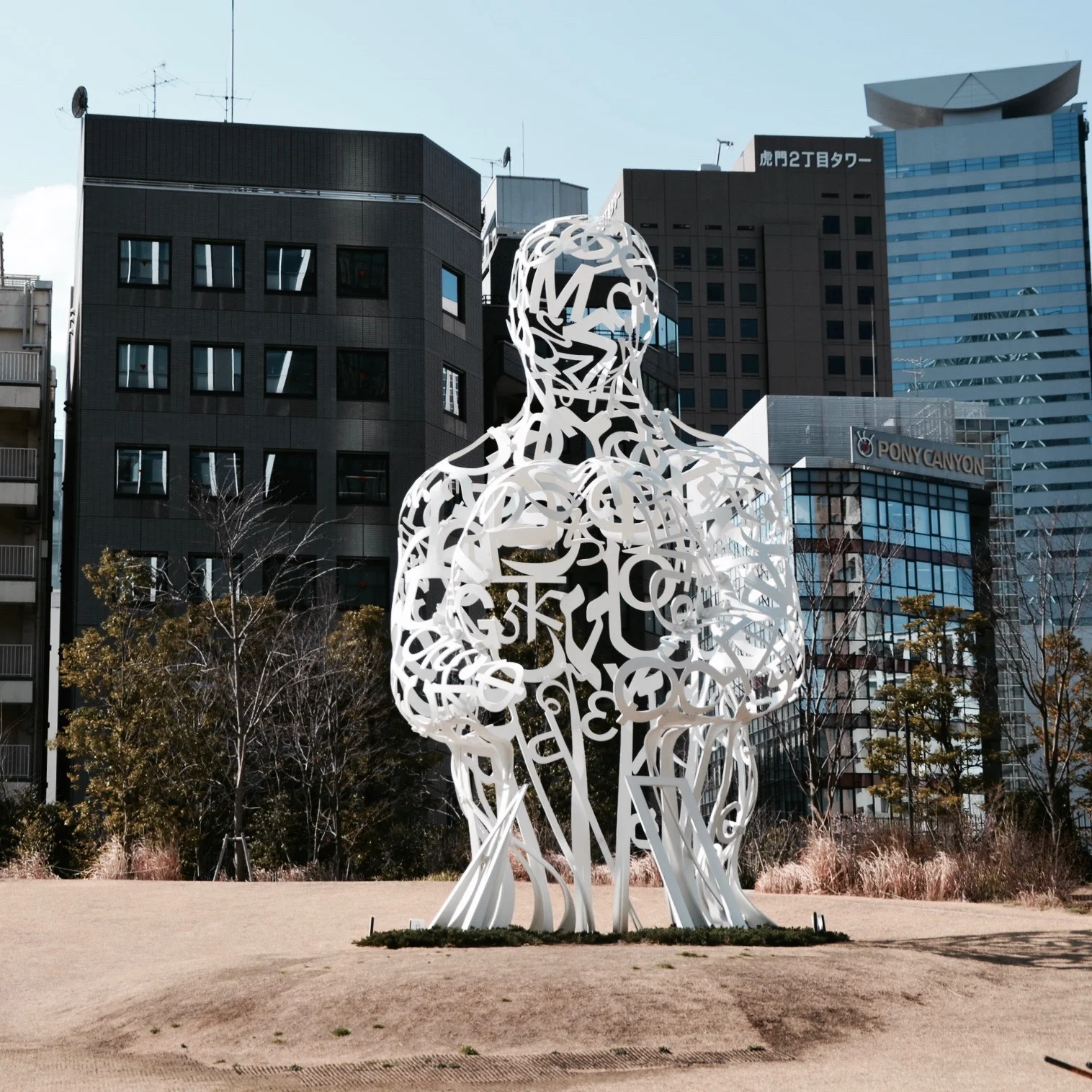
Jaume Plensa’s Roots and the Making of Toranomon Hills
The commission also expresses the developer’s ambitions for the district. At the unveiling, Mori linked the work’s cultural diversity to its plans for an international business community, attracting people and capital to Toranomon. Plensa’s interest was in creating a meeting place where people could pause and share space. Those intentions meet on this lawn, though they should be judged separately.