Artist: Retna
Title: Stairway to the Sun [escaleras al sol]
Mural Date: 2017, [Beauty Project México]
Building Name: Cuauhtemoc, by architect Mario Pani built in 1960.
Stories: 21
Neighborhood: Tlatelolco, CDMX
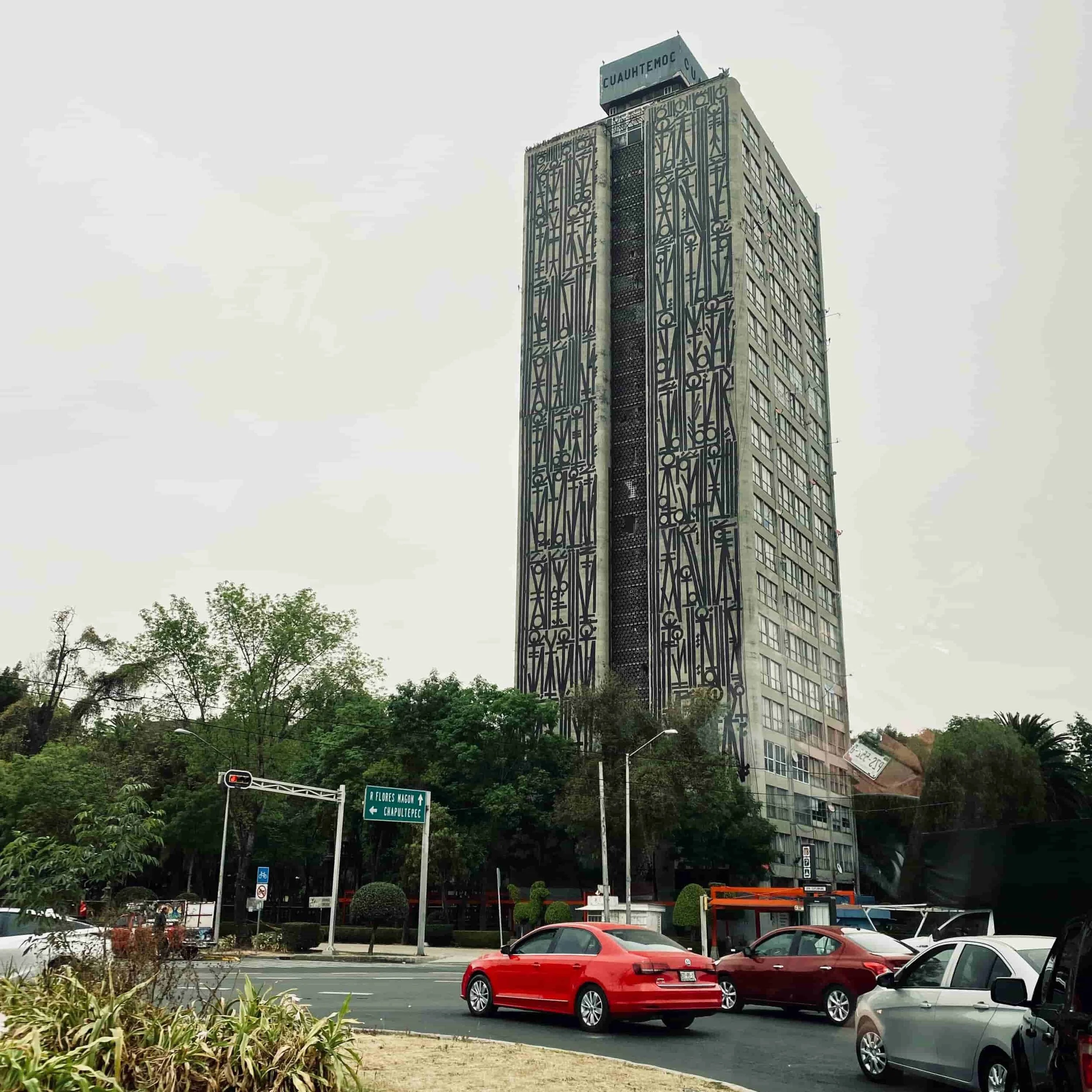
RETNA, Escaleras al Sol, 2017. Edificio Cuauhtémoc, Tlatelolco, Mexico City. Photograph by Nadia Bouzid, February 2, 2020.
RETNA’s lettering takes up the narrow end of the Cuauhtémoc building in Tlatelolco. Beside it, rows of balconies reveal curtains, open windows and clothes drying outside. The photograph holds both at once: a carefully ordered composition and a residential façade that changes a little with every household.
Painted in 2017 as part of The Beauty Project México, Escaleras al Sol uses the tower’s proportions to good effect. The white characters extend up a dark vertical field, with little room to spread sideways. Next to them, the repeated balcony slabs make the height legible floor by floor. The architecture gives the lettering its pace.
There is a text behind the symbols. The Spanish poem published alongside the project refers to the Feathered Serpent, peace and the recovery of sight. Its imagery provides a connection to Mexico beyond the mural’s location. Without that accompanying text, the marks remain difficult to decipher, even though their arrangement makes it clear that there is something to read.
The choice of building is equally interesting. Cuauhtémoc belongs to Mario Pani’s Nonoalco Tlatelolco, a housing complex inaugurated in 1964. The original plan included 102 apartment buildings, with shops, schools and open space woven into the development. Pani was working at the scale of a district, considering how daily life would be organized beyond the apartment door.
Even the apparent repetition of the buildings concealed distinctions. As architectural historian Cristóbal Andrés Jácome Moreno describes, the plan allocated different sizes and standards of accommodation to different income groups, with larger apartments in taller buildings near Paseo de la Reforma. The clean geometry carried a social hierarchy.
Art also had a place in this vision. Carlos Mérida’s mural on Pani’s Torre Insignia, originally built for Banobras, predates RETNA’s intervention by decades. The commissions are separate, but that earlier work complicates the familiar account of street art bringing culture to an overlooked housing estate. Tlatelolco already had artists, architectural ambitions and a substantial public history.
The Beauty Project presented beauty as something that could improve the experience of the city. In Tlatelolco, that proposition meets a particularly demanding setting. The archaeological site, the church of Santiago, the modern housing, the massacre of 1968 and the earthquake of 1985 all belong to the neighborhood’s history. A mural becomes part of that setting without resolving its contradictions.
Here, the relationship between painting and building is precise enough to reward a closer look. The lettering follows the tower’s vertical proportions; the balconies keep its residential scale in view. Crop them out and the photograph loses much of what makes this particular RETNA worth looking at.
The piece is called Escaleras al Sol (Stairway to the Sun)
“We are the Sons of our Plumed Serpent. We will return to guide our soul, stretching a hand of peace, with tears in my eyes, I shed the dust from the sight we’ve lost, and I will return to my symbolic form, to land in the shadow of the Sun.”