Black and White Flamingos by Nitzan Mintz and Dede Bandaid
Artists: Nitzan Mintz and Dede Bandaid
Title: Black&White Flamingos
Location: Alfred I. duPont Building
Address: 169 East Flagler Street, Miami, Florida
Neighborhood: Downtown Miami
Date: December 2019
Building completed: 1939
Architects: Marsh & Saxelbye
Architectural style: Art Moderne
Whenever I see Black&White Flamingos, I stop and read the words again. They never land in quite the same place. Some days, I read them as letting go. On others, they are about freedom, or the relief of disconnecting from something that has felt too heavy. After a long day, the same words can bring me peace. They can even feel grounding, although they speak of floating. The mural stays exactly where it is, but my reading of it changes according to whatever I happen to be carrying that day.
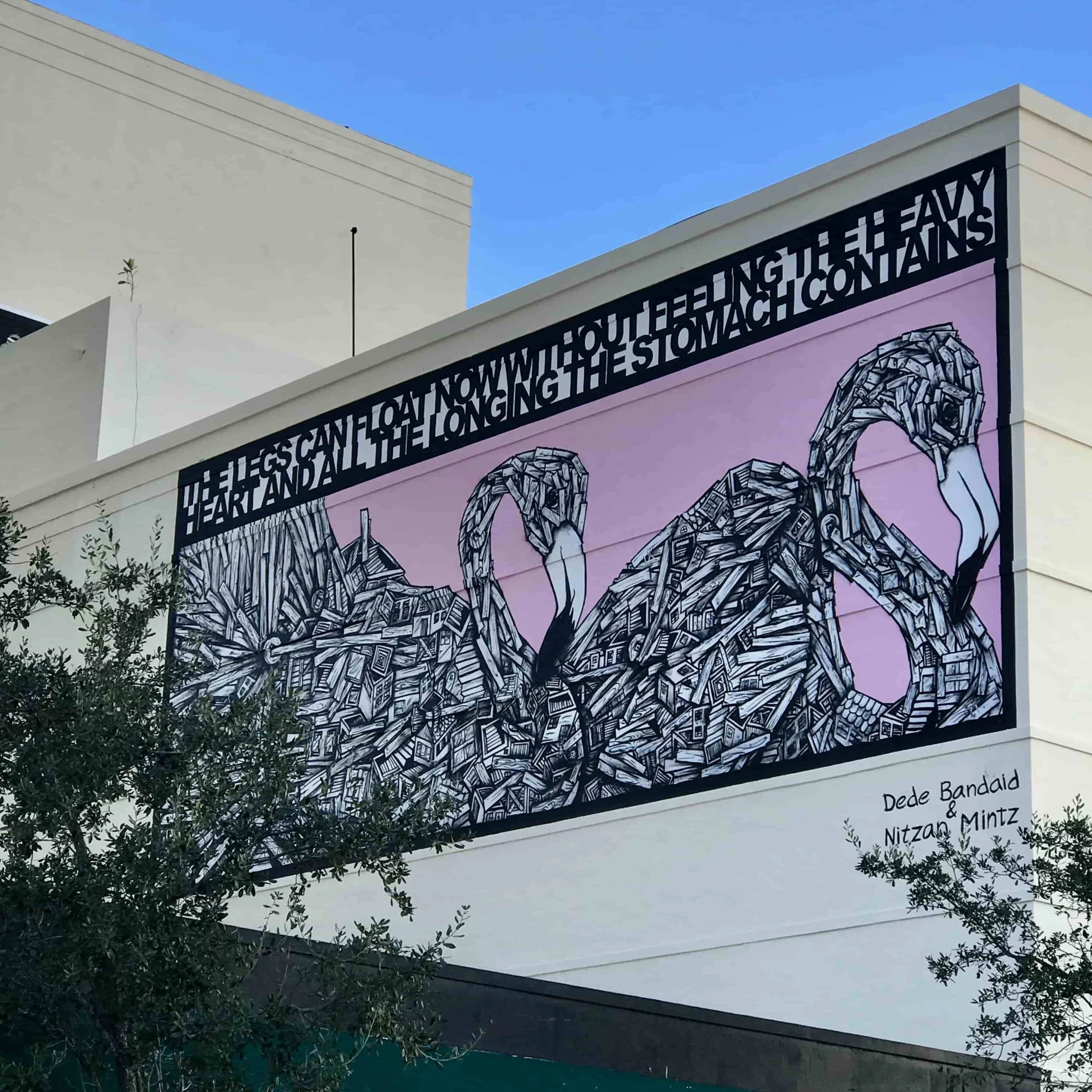
photo by Nadia Bouzid
The mural was created by Israeli artists Nitzan Mintz and Dede Bandaid at the Alfred I. duPont Building in December 2019. Two black and white flamingos appear above a passage:
“The legs can float now without feeling the heavy heart and all the longing the stomach contains”.
Most flamingos in Miami arrive pink. These have been stripped of color and assembled from what looks like the discarded anatomy of a city: pieces of wood, furniture, beams, windows and architectural debris. From a distance, they read as complete birds. Up close, their bodies reveal all the unrelated fragments being held together.
The sentence above them was not written to describe the flamingos. It came from a longer poem Mintz created in 2018 for the historic synagogue in Ostrów Wielkopolski, Poland, where it appeared in Hebrew and Polish across an exterior wall. In Miami, one passage from that poem reappeared in English above the two birds.
Mintz was born in Israel in 1989 and studied fine art and creative writing at Minshar College in Tel Aviv, as well as poetry at the Helicon School of Creative Writing. She describes herself as a visual poet because the words are only one part of the work. The wall, typography and history of the location shape how the poem is seen and read.
Her poetry has appeared in public spaces in Tel Aviv, Berlin, Vienna, Prague, Łódź, Ostrów and Miami. Some pieces are painted directly onto buildings. Others are constructed from industrial paint, salvaged wood and materials gathered from the street. Her poems move between personal memory and larger questions of belonging, relationships and place.
Dede Bandaid is a multidisciplinary urban artist who has kept his legal identity private. His precise age is not reliably documented, and he has chosen to work under the name Dede for most of his career. He began creating work in the streets of Tel Aviv during and after his military service and later studied at the Bezalel Academy of Arts and Design.
The bandage became his signature image. He has described it as something that began with a desire to express and heal his own wounds before developing into a symbol for personal and social damage. He placed bandages on walls and deteriorating buildings around Tel Aviv, using something associated with a minor injury to mark fractures that were considerably harder to repair.
His practice eventually moved beyond the bandage into paintings, murals, collage, assemblage and large installations. One recurring series consists of animals whose bodies appear to be made from discarded furniture, construction remnants and pieces of architecture. His birds and animals have appeared in Prague, Munich, London, Łódź, Tel Aviv and other cities, with their forms changing in response to the places where they are installed.
Mintz and Dede are partners, but their work remains recognizably individual. Mintz brings language, while Dede gives the work a physical creature or structure. The text does not simply explain the image, and the image does not reduce the poem to an illustration. Each leaves room for the other to be read differently.
In April 2018, Mintz travelled to Ostrów Wielkopolski to create a poem on an exterior wall at the city’s historic synagogue. The commission involved the Urban Forms Foundation and the Ostrów Cultural Centre, with the participation of the Municipality of Ostrów, the synagogue management and the Israeli Embassy in Poland, which supported the artist’s arrival. Sebastian Górski, then director of the cultural centre, had been looking for a project appropriate to the history and immediate surroundings of the synagogue.
Mintz learned about Ostrów and the Jewish population that had once lived there before writing the poem. Joanna Goldstein translated the Hebrew into Polish, and the two languages were painted side by side in black lettering across the wall. The words become almost architectural, running vertically and horizontally around the building’s windows rather than sitting within a conventional block of text.
The location also held a personal connection for Mintz. She is of partial Polish ancestry, and her grandfather grew up in Poland. She later wrote about the distance between what he had experienced there as a Jew and the warmth with which she herself was received generations later. Her poem does not narrate that history, but it carries the complicated act of leaving a place while continuing to hold it inside the body.
This is the complete English translation published by Mintz:
“There is no evil in the legs
they do not walk by themselves
there’s someone in the rising of the thigh
in the rising of the spine
He’s focusing the eye onward.The legs can float now
without feeling the heavy heart
and all the longing the stomach contains
the legs are no prison
and everything is light
as a feather”.
The opening line, “There is no evil in the legs,” places responsibility somewhere other than the body part that leaves. The legs do not walk by themselves. Something directs the thigh, the spine and finally the gaze. The eyes look forward while the heart retains its weight and the stomach keeps the longing.
Then the poem changes. The legs are no longer a prison. They can float without feeling everything being carried above them, and the body becomes light as a feather. It can be read as freedom, but it can also feel like detachment. There is relief in it, although not necessarily forgetting.
While Mintz worked at the synagogue, Dede completed a separate commission across from a local high school. He created a stork from images of discarded wood, furniture and architectural fragments. According to the project organizers, the migrating bird referred both to the past and to the arrival of spring. It is another example of how he uses an animal associated with a particular place and constructs its body from materials that appear to have been left behind there.
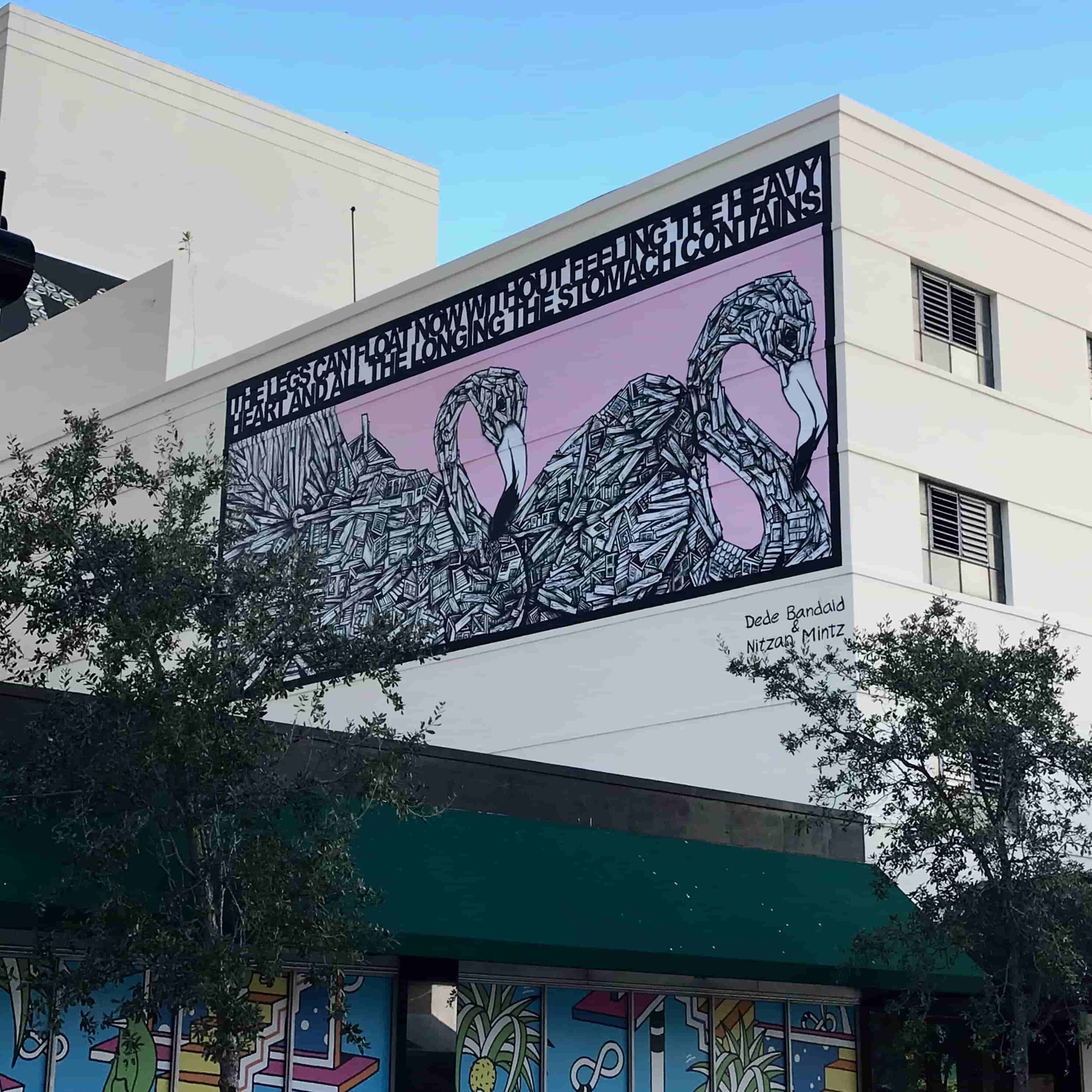
photo by Nadia Bouzid
The passage used in Miami comes from the middle of the poem. In Ostrów, it appeared as part of a larger work in Hebrew and Polish. In Miami, the English excerpt sits above Dede’s flamingos, without the synagogue or the rest of the poem to explain where it came from. The legs, the heart and the stomach remain, but the setting has changed completely.
The Alfred I. duPont Building gives the words another setting. Completed in 1939 for Alfred I. duPont’s Florida National Bank, the building belongs to the period when banks used architecture to communicate permanence. Marble, decorative plaster, metalwork and heavy doors made the institution feel as though it would remain in place regardless of what happened outside.
Its historic brass elevator doors are decorated with tropical vegetation, birds and flamingos in relief. The Alfred I. duPont Building already had its own flamingos long before Mintz and Dede arrived. In 2019, another pair appeared outside the building, this time black and white, visibly fragmented and suspended beneath a poem about weight, longing and release.
The older flamingos remain pressed into the polished brass of the elevator doors. Outside, the newer birds appear pieced together from debris. They were made eighty years apart. One was built into the architecture and intended to remain; the other lives on an exterior wall, exposed to weather, repainting and whatever plans may eventually be made for the building.
That is part of the nature of street art. A work can become attached to a place without ever being promised permanence, and sometimes the photograph lasts longer than the work itself. What was once encountered casually on a walk can eventually become part of the visual record of a city.
Miami has used the flamingo so often that the bird can disappear into decoration. Here, it loses the pink, the kitsch and the promise of an endless vacation. What remains is its improbable body, balanced on legs that appear too thin to support its weight and perfectly designed to do exactly that.
Perhaps this is why the mural gives me a different feeling every time. “The legs can float now” can feel like freedom one day and disconnection the next. Sometimes it is about letting go. Sometimes it brings relief, as if the body could stop absorbing everything the heart and stomach insist on holding. After a long day, I can read the same sentence and feel unexpectedly still.
The words do not change, and neither do the flamingos. I do. What I notice in them depends on the day, the weight of it and what I may be ready to put down.