Puerto Morelos is not Tulum, and that may be the point

Location: Puerto Morelos, Quintana Roo, Mexico
Municipality: Puerto Morelos
Population: 26,921, 2020 Census
Cancún International Airport: Approximately 18 km
Municipality established: 2015
Tren Maya Puerto Morelos station opened: February 2024
Coastal protection: Parque Nacional Arrecife de Puerto Morelos
Primary road connection: Federal Highway 307
Puerto Morelos sits just south of Cancún, approximately 18 kilometers from the airport and close enough that, without terrible traffic, you can be at the beach not long after collecting your luggage. On a map, that should make it feel almost like an extension of Cancún. It doesn't. Around the square and waterfront, the buildings get smaller, the streets quieter and the pace changes quickly enough that the distance feels greater than it is.
It still feels like a village in places, although that description needs some qualification. Puerto Morelos is not an undiscovered fishing village waiting for someone to find it. Tourism and development have been here for decades. There are large resorts along the coast, substantial population on the other side of Highway 307 and a municipality that extends well beyond the handful of streets most visitors know. What has survived is the scale of the old center, and that is a different thing.
It is also a completely different proposition from Playa del Carmen or Tulum. Playa is denser, busier and far more built up, but it still has that slightly gritty Mexican Caribbean quality once you move away from the polished stretches of Fifth Avenue. Traffic, small businesses, construction, apartment buildings, tourists and ordinary local life sit on top of one another. Tulum feels different again. Its recent growth has been far more self conscious, with hotels, restaurants, architecture and new residential development becoming part of the destination itself. Puerto Morelos has escaped much of that intensity. Around the old center, it still feels small.
That difference is exactly why I am suspicious when Puerto Morelos is described as the next Tulum. If it became Tulum, much of the reason for buying there would disappear. Puerto Morelos makes more sense for someone who wants Cancún and its airport close enough to be convenient, can get to Playa when they want more activity, but does not particularly want to live in either one.

Realestate Opportunities in Puerto Morelos | photo by Nadia Bouzid
The beach also deserves a little honesty. The sea here is not always the extraordinary electric turquoise that people imagine when buying property in the Mexican Caribbean. Depending on weather, currents, season and sargassum, the water can look darker and less transparent. That does not make the coastline unattractive, but it is something I would want to know before paying a substantial premium for an ocean view based on a particularly cooperative day in February.
What sits offshore is considerably more consequential to the real estate. The Arrecife de Puerto Morelos has been a federally protected national park since 1998, covering more than 9,000 hectares and forming part of the Mesoamerican Reef system. Behind the coast are mangroves, wetlands and a sensitive groundwater system. The empty looking parcel beside the Caribbean is therefore not necessarily a blank piece of land waiting for an architect.
This is where Puerto Morelos becomes more interesting than the usual story about finding somewhere cheaper than Tulum. Its relatively modest scale is partly the result of geography, environmental constraints, land ownership and planning. Development has been happening here for a long time, but the ability to build is not as simple as looking at an empty lot and calculating how many condominiums might fit on it.
Puerto Morelos itself is a young municipality. It became Quintana Roo's eleventh municipality in 2015 after previously belonging to Benito Juárez, which includes Cancún. By the 2020 census, the municipality had 26,921 residents, a number that seems surprisingly large if your experience of the place is limited to walking around the square and having lunch near the beach.

📍Puerto Morelos, Quintana Roo
The geography explains some of the discrepancy. The old coastal settlement sits east of Highway 307. Joaquín Zetina Gasca developed on the other side around what was historically known as El Crucero. Larger resorts extend north and south along the coast, while the municipality continues inland toward Leona Vicario. Two properties can therefore both be advertised as Puerto Morelos while having very little in common beyond the municipality on the address.
For a buyer, I would understand that geography before becoming too interested in price per square meter. A condominium a few streets from the square, a villa farther up the coast and a parcel west of Highway 307 are completely different real estate decisions. Their access, surroundings, development rights, rental possibilities and eventual buyers are unlikely to be the same.
Land requires particular care. Puerto Morelos has a substantial history of ejidal ownership. The Puerto Morelos ejido was established in 1936 with more than 21,000 hectares, with additional land incorporated later. That history still matters when evaluating property today, particularly when land is being sold with a story about what somebody will eventually be able to build there.
I would want to know exactly what I was buying before discussing the architecture or the potential return. Is it private property today? If the land originated as ejido, was the conversion properly completed? Is the title clean? Are there liens or competing claims? Does it have legal access and utilities? What does the applicable planning framework actually permit rather than what someone believes will eventually be permitted?
These are not uniquely Puerto Morelos questions, but the land history makes them particularly relevant here. A cheap parcel with complicated title or development rights can become very expensive long before construction begins.
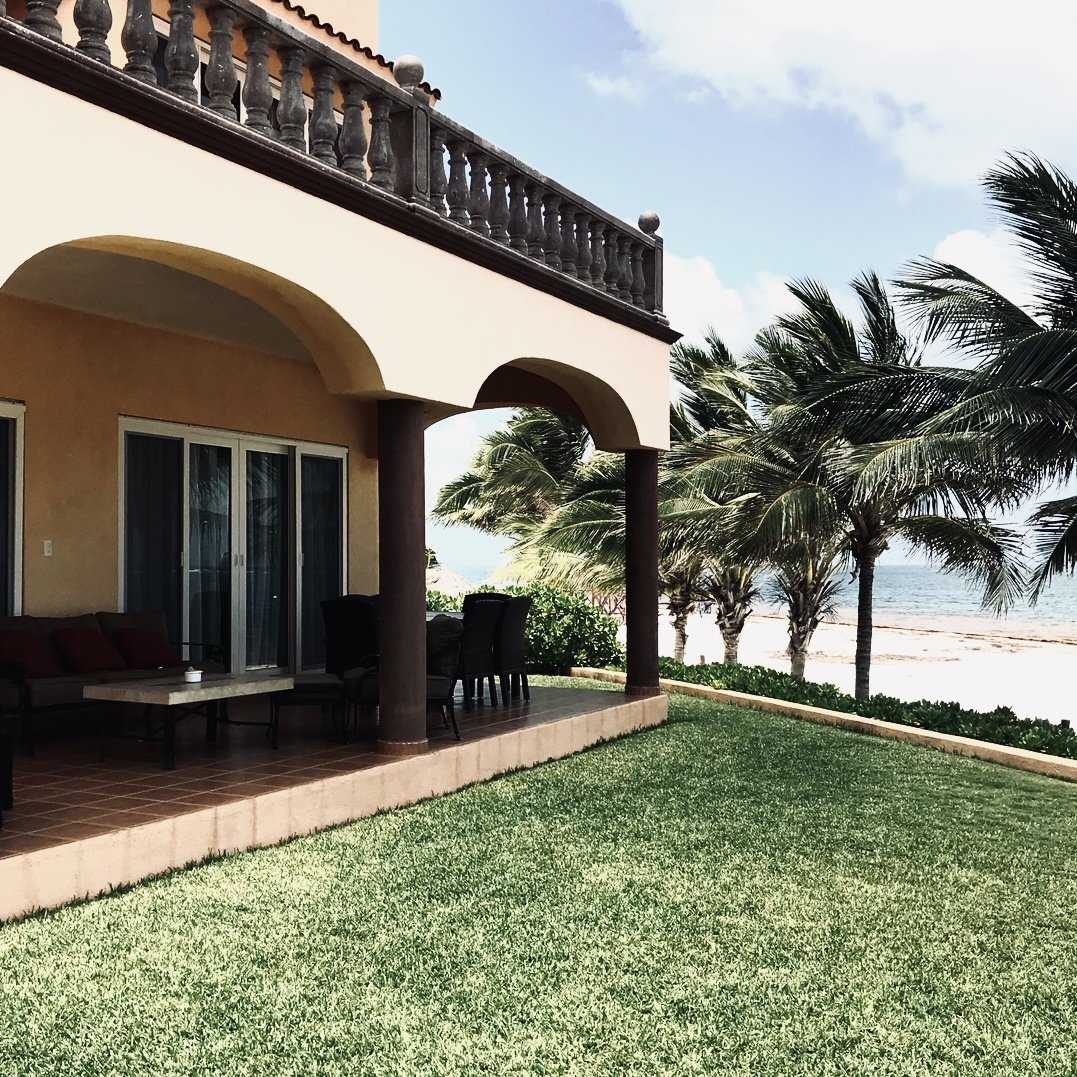
Vacation Rentals in Puerto Morelos | photo by Nadia Bouzid
Foreign ownership adds another layer, although it is a familiar one throughout coastal Mexico. Puerto Morelos falls within the constitutionally restricted coastal zone, so foreign residential buyers generally acquire beneficial rights through a Mexican bank trust, or fideicomiso. It is a normal ownership structure, but I would still have the trust, title and closing documents reviewed by independent Mexican counsel rather than treating normal as synonymous with automatic.
With a condominium, I would spend less time admiring the rooftop pool and more time understanding the building. Coastal properties age differently. Salt, humidity, wind and storms are hard on concrete, metal, glass, waterproofing and mechanical equipment. A beautifully finished new building can look very different after several years if the original construction was mediocre or the condominium has been reluctant to spend money on maintenance.
For someone buying a second home to spend several months a year here, the questions become wonderfully unglamorous. Who manages the property when most owners are away? What reserves does the condominium have? Are there assessments? What does the insurance cover? Is there backup power? How is water handled? What happens to the building when a hurricane is approaching? If there is an elevator, who services it when it stops working?
Those things begin to matter more than the lobby surprisingly quickly.
I would also question the automatic assumption that beachfront is always the best purchase. Being directly on the water commands a premium, but it also means greater exposure to salt, wind and storms. In a town this compact, being a few streets back can still mean walking to the beach and the square while owning something that may be easier to maintain. The right choice depends on whether the property is primarily a home, an occasional rental or an asset being held with resale in mind.
The planning situation in 2024 adds another layer. In 2021 the municipality approved an urban development program covering 2020 to 2030. Residents challenged it, and in October 2023 Mexico's Supreme Court ruled in their favor, ordering the program set aside and redone after finding deficiencies in citizen participation and access to environmental information.
For anyone underwriting development land, that should slow the spreadsheet down. Future density is not an entitlement because it would make a project financially attractive. A parcel can look inexpensive when the buyer is mentally dividing the purchase price by the number of units they hope to build rather than the number legally permitted.
For a residential buyer, the same planning fight looks different. I would want to understand what can be built around the property, not only what can be built on it. A low rise building with an open view can be an excellent purchase until the parcel across the street receives considerably more density than expected. An ocean view is particularly valuable when something besides optimism protects it.

Ocean Front Condos in Puerto Morelos | photo by Nadia Bouzid
The timing is interesting because another piece of infrastructure has just arrived. The Puerto Morelos Tren Maya station opened in February 2024, adding rail to a location already connected by Highway 307 and unusually close to Cancún International Airport. For someone who plans to use a property frequently, airport proximity has real value. A second home becomes considerably more useful when getting there does not require adding another long drive after the flight.
I would be much more cautious about the argument that the train automatically makes nearby land a good investment. Infrastructure changes how people move, but value rarely spreads evenly around it. What interests me more is whether better connectivity changes which parts of Puerto Morelos become viable for housing, services and commercial development, particularly around Highway 307 and on the inland side where the land economics are different from the coast.
The arrival of the train also makes the split between the Puerto Morelos visitors see and the municipality around it harder to ignore. The postcard version is the small coastal center. The growth story is much larger.
Tourism here is not new either. Municipal history records roughly 60 hotel rooms around 1980, more than 2,000 by 2000 and approximately 10,000 by the time Puerto Morelos became its own municipality. Much of the larger resort inventory sits north and south of town rather than directly around the square, which helps explain how the center has retained its scale while a substantial tourism economy developed around it.
That physical separation may be one of the better things Puerto Morelos has going for it. You can have large resorts nearby without the old town reading as one continuous hotel district. The center remains a mixture of houses, restaurants, small hotels, shops and ordinary local life rather than a controlled resort environment.

Puerto Morelos | photo by Nadia Bouzid
For someone who already owns property elsewhere, that can be more appealing than another destination designed to provide everything without ever requiring you to leave the property. Puerto Morelos is not going to entertain you every minute. Cancún is close when you need it. Playa is accessible when you want more restaurants, shopping or activity. Then you can return somewhere considerably smaller.
There is also a maturity to buying this way that has little to do with maximizing rental yield. If a property is primarily a second home, the ability to reach it easily, use it frequently and maintain it without constant drama may matter more than whether another location produces a few additional percentage points of theoretical return.
If rental income is part of the decision, I would still want to see actual numbers rather than projections built for a sales presentation. Occupancy is only the beginning. Management fees, condominium fees, utilities, insurance, taxes, maintenance, furnishings and replacement costs all sit between gross rent and what the owner actually keeps. A coastal rental also experiences considerably more wear than an apartment occupied by its owner for a few months each year.
The same skepticism applies to the phrase “affordable compared with Tulum.” Relative affordability is not an investment thesis. A property can cost less because the market is earlier, because demand is lower, because development rights are more limited or simply because it is worth less. The interesting work is determining which one applies to the particular property.

Pelican art in Puerto Morelos | photo by Nadia Bouzid
What makes Puerto Morelos compelling is not that it is waiting to become somewhere else. It sits just outside Cancún, close to one of Mexico's busiest international airports, between two established Riviera Maya markets and beside a federally protected reef. It has substantial tourism and new infrastructure, but the old coastal center has retained a scale that feels completely different from Playa or Tulum.
That creates an unusual tension for development. The qualities attracting buyers are some of the same qualities that aggressive development could easily remove. Low buildings, access to the water, quieter streets and a center that still feels like a village all have economic value even though none appears as a separate line in a development pro forma.
A good project here should probably understand that before trying to extract every possible square meter from the site. More density can create more units, but more units do not necessarily create a better property or a more valuable town. In a place where scarcity is part of the attraction, restraint can have its own economics.
I would approach an existing property the same way. Clear title, sensible construction, good management, a location I understand and a building I would still want to own in ten years interest me more than a dramatic rendering or a promise that Puerto Morelos is about to explode.
The best way to understand the market is probably to spend enough time here to become slightly bored. See the water when it is not perfect. Walk the streets behind the beach. Cross Highway 307 and understand what exists on the other side. Drive north and south and see where the large resorts actually sit. Look at the town on an ordinary weekday rather than only over dinner on a beautiful evening.
Then decide whether the quiet is something missing or the thing you came for.
For the right buyer, particularly someone who already has the city house, the busy life and perhaps another property somewhere else, Puerto Morelos does not need to become Tulum to make sense. Its value may lie in remaining recognizably itself while almost everything around it continues to build.
Why Invest in Puerto Morelos Real Estate?
1. Booming Tourism Industry: Puerto Morelos benefits from its proximity to popular tourist destinations such as Cancún and Playa del Carmen, attracting a steady stream of visitors year-round. As tourism continues to grow in the region, demand for vacation rentals, beachfront condos, and luxury properties in Puerto Morelos is on the rise.
2. Affordable Investment Opportunities: Compared to neighboring resort towns, Puerto Morelos offers relatively affordable real estate prices, making it an attractive option for investors seeking high returns on their investment. Whether you're interested in purchasing a vacation home, rental property, or land for development, Puerto Morelos provides a range of investment options to suit every budget.
3. Stable Property Market: Despite fluctuations in the global economy, the real estate market in Puerto Morelos remains stable and resilient. With strong demand from both domestic and international buyers, properties in Puerto Morelos have maintained their value over time, offering investors a secure and reliable investment opportunity.
4. Natural Beauty and Lifestyle: Beyond its investment potential, Puerto Morelos offers a desirable lifestyle characterized by pristine beaches, turquoise waters, and a laid-back atmosphere. Investors and residents alike can enjoy a wide range of outdoor activities, from snorkeling and diving to dining at waterfront restaurants and exploring the town's charming streets.

Land Investments in Puerto Morelos | photo by Nadia Bouzid
Types of Real Estate Investments in Puerto Morelos
1. Vacation Rentals: With its year-round appeal to tourists, Puerto Morelos is an ideal location for vacation rental properties. Investors can capitalize on the demand for short-term accommodations by purchasing condos, villas, or beachfront homes to rent out to vacationers seeking an authentic Mexican getaway.
2. Beachfront Condos: Beachfront condos are a popular choice among investors looking to enjoy panoramic ocean views and direct access to the beach. These properties offer a luxurious lifestyle with amenities such as swimming pools, fitness centers, and concierge services, making them highly desirable for both vacationers and long-term residents.
3. Land Investment: For investors seeking development opportunities, purchasing land in Puerto Morelos provides a blank canvas for creating custom-built homes, boutique hotels, or eco-friendly resorts. With ample undeveloped land available, investors can take advantage of the growing demand for unique and sustainable accommodations in the area.