One Biscayne Tower Still Holds Its Place in Downtown Miami

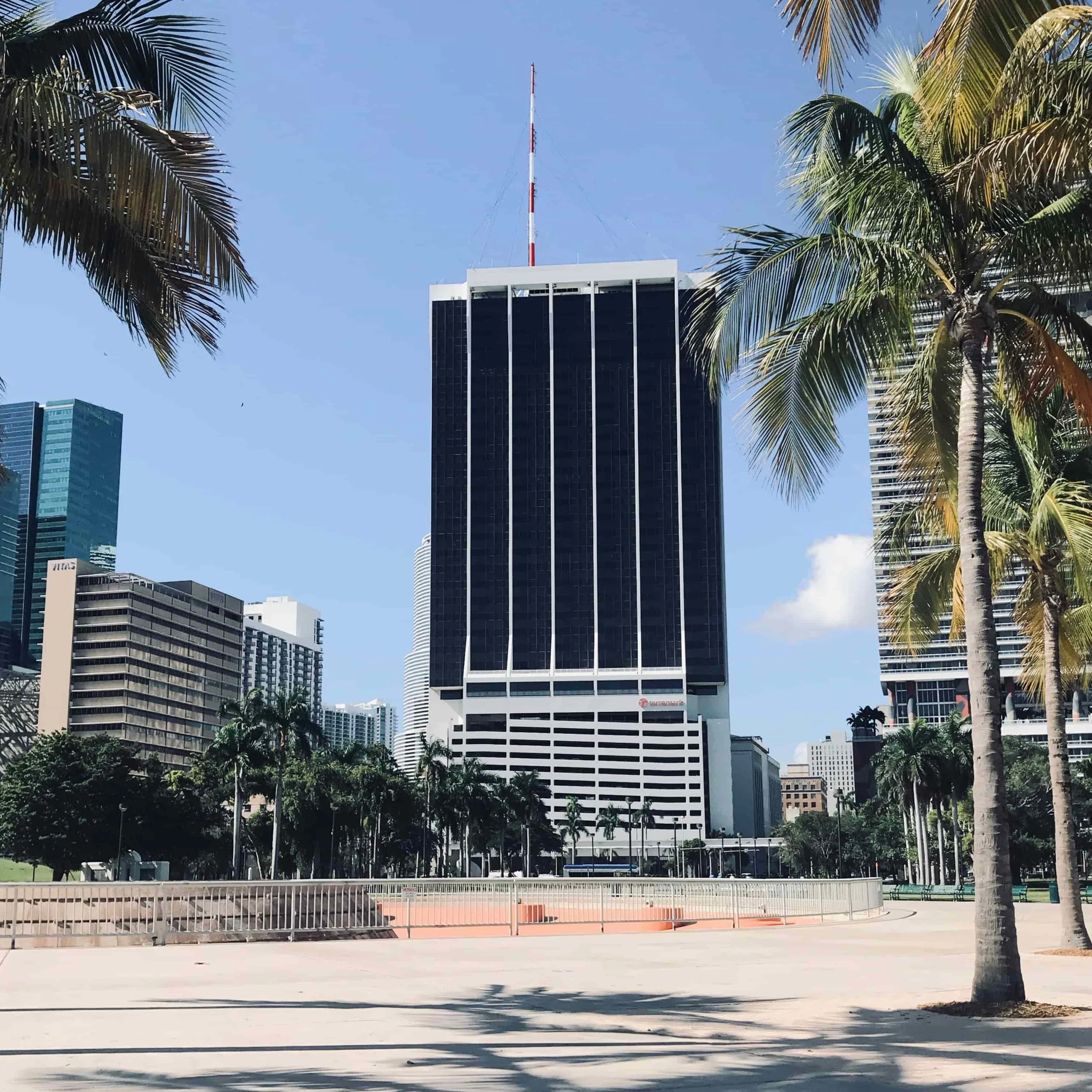
One Biscayne Tower | photo by Nadia Bouzid
Address: 2 South Biscayne Boulevard, Miami, FL 33131
Neighborhood: Downtown Miami
Property Type: Office tower
Completed: 1973
Height: 492 feet
Stories: 39
Tower Size: 619,678 square feet
Developer: Trammell Crow Company
Architecture: Humberto P. Alonso, Pelayo G. Fraga & Associates and E.H. Gutierrez & Associates
One Biscayne Tower is so familiar that it can disappear in plain sight. It sits along Biscayne Boulevard, behind Bayfront Park, and I usually register it before I consciously look at it: the pale concrete grid, the dark windows and that broad face turned toward the bay. Downtown has become crowded with newer towers, but One Biscayne still has one of its clearest silhouettes.
The building looks different depending on where Miami happens to place you. From the bay, it appears tall and narrow. From Biscayne Boulevard, it feels wider and much heavier because the parking structure becomes part of the view. The concrete is bright in the afternoon and almost gray before a storm. The windows sit deep enough inside the frame to keep changing with the light.
Completed in 1973, One Biscayne Tower rose 492 feet and became the tallest building in Miami. It remained the tallest until the Southeast Financial Center was completed in 1984. For much of the 1970s, photographs of Downtown were organized around it. The tower gave the skyline a center before Miami had very much of a skyline to arrange.

One Biscayne Tower | Photo by Nadia Bouzid
Trammell Crow Company developed the building, and its architecture is credited to Humberto P. Alonso, Pelayo G. Fraga & Associates and E.H. Gutierrez & Associates. These were Cuban architects working in a city being transformed by Cuban professionals, businesses and capital. Their contribution to Miami was not happening quietly, and One Biscayne placed it directly on the skyline.
The tower appeared in a July 1973 National Geographic article titled “Cuba’s Exiles Bring New Life to Miami.” It is difficult to separate the building from that moment. This was a commercial office tower, but it was also a very visible sign of who was helping to build the new Miami.
The façade is disciplined without being boring. Concrete piers run vertically along the tower, with dark windows recessed between them. The repetition gives the building its scale and makes it easy to recognize from a distance. On the narrow side, the lines come closer together and the tower feels almost graphic. The wider elevation reveals how large the office building actually is.
The concrete has given One Biscayne a weight that the newer glass towers do not have. It also creates deep shadows across the façade, which helps such a large building handle Miami’s very direct light. The architects received an Outstanding Concrete Structure in Florida award in 1973. Nearly five decades later, the concrete frame remains the strongest part of the building.
The seven-story parking garage is less poetic, but it is very Miami. Office buildings here were expected to make room for cars, and One Biscayne made room for many of them. The garage occupies a considerable portion of the base and creates a harder edge along the street, especially across from Bayfront Park. It also gives the property something every Downtown office tenant continues to ask about almost immediately: parking.
The upper tower has aged better than its relationship with the sidewalk. Above the garage, the architecture is ordered and distinctive. At street level, the building belongs to an older version of Downtown, one designed around people arriving in the morning, disappearing into their offices and driving away at the end of the day.
That version of Downtown is changing. More people are living east of Biscayne Boulevard, the Metromover moves residents and office workers through the neighborhood, and MiamiCentral has begun bringing passengers into the center of the city. Bayfront Park is directly across the street. A location this central can no longer function only from nine to five, even if much of the surrounding street life still does.
For an office building, the address is difficult to improve upon. One Biscayne has immediate access to Biscayne Boulevard, Brickell Avenue, I-95 and the MacArthur Causeway. The Bayfront Park Metromover station is steps away, and the upper floors look over the park toward Biscayne Bay. Those views belong to the site. They cannot be added later as part of a renovation.
The building also has the regular floor plates expected from a large commercial tower. Tenants can understand the structure, the window spacing and the relationship between the core and the perimeter. Recognition may bring someone through the door, but an office building survives because the space works, the elevators move, the parking is manageable and the location makes the workday easier.
One Biscayne has lived through several versions of the Downtown office market. New buildings arrived with larger lobbies, newer mechanical systems and more glass. Banks changed names. Residential towers moved closer to the boulevard, and the blocks around Flagler Street continued their uneven cycle of activity, vacancy and new promises.
Through all of it, the tower remained remarkably easy to identify. Its name, address and architecture stayed connected, something Miami real estate does not always manage. There was no need to search for One Biscayne Tower on the skyline. You simply knew which one it was.
One Biscayne no longer dominates Downtown, which may be why it deserves a closer look now. It has moved from the center of the skyline into its background without losing its outline. In Miami, where a building can look dated before the landscaping grows in, nearly fifty years of visual clarity is worth noticing.

Downtown has changed around it more than once, and it is about to change again.
Downtown’s office story is easier to read when One Biscayne Tower is considered alongside Southeast Financial Center, the Miami Tower, and the empty storefronts at street level.
One Biscayne Tower was once the tallest building in Miami. The building appears in a July 1973 article of National Geographic titled, "Cuba's Exiles Bring New Life to Miami." It was designed by Cuban architects Humberto P. Alonso, Pelayo G. Fraga & Associates and E.H. Gutierrez & Associates. The architects received a 1973 Outstanding Concrete Structure in Florida award.
One Biscayne Tower has won five Office Building of the Year (TOBY) Awards, including the 2007 Miami-Dade TOBY Award and the 2007 BOMA Southern Regional TOBY.



Occupancy is anticipated for 2020