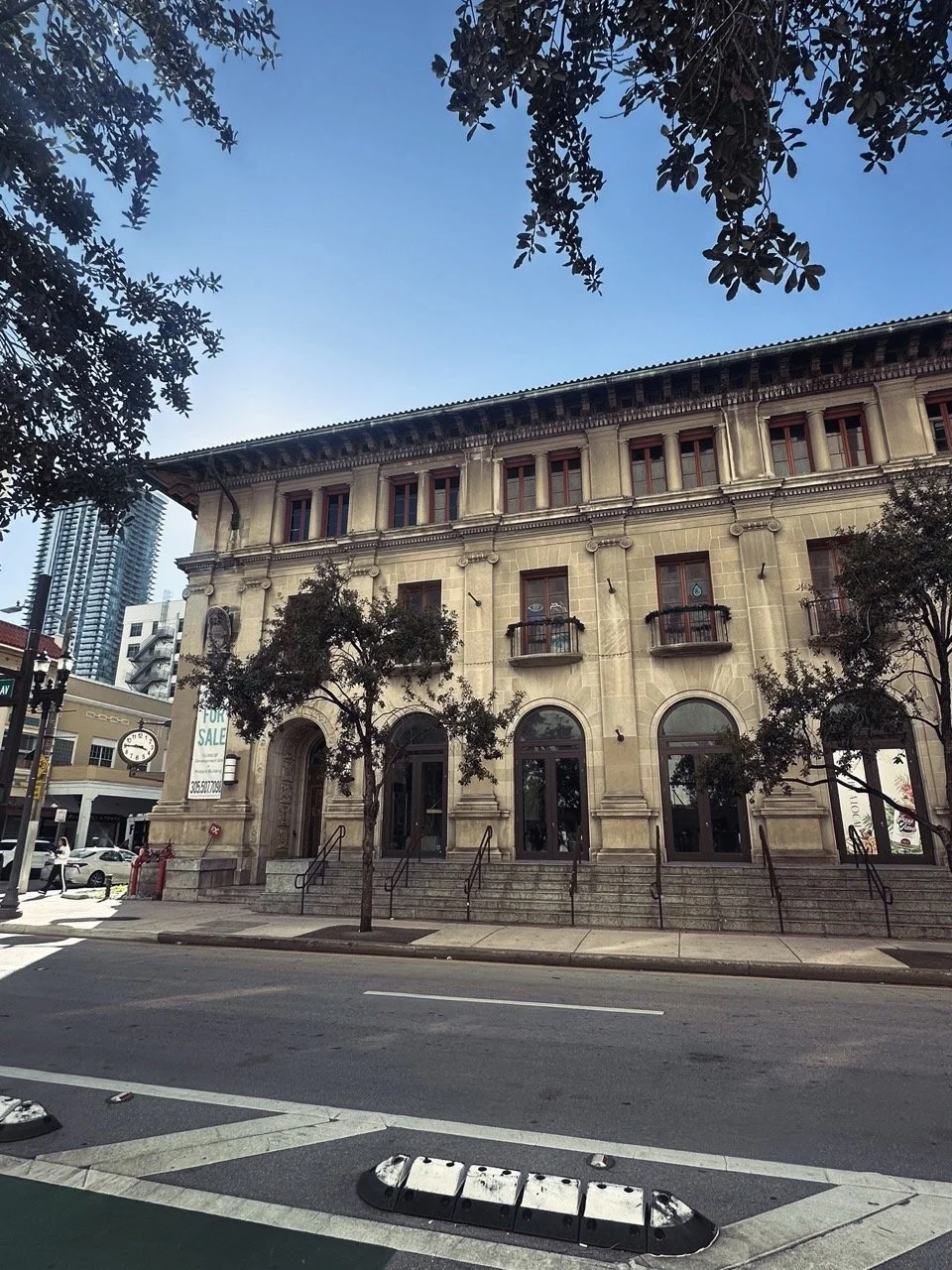
The Old U.S. Post Office on Northeast First Avenue
The Old U.S. Post Office on Northeast First Avenue was offered with 214 units of residential density and 142,129 square feet of transferable development rights, both subject to verification and approval. The same brochure offered a vacant lot next door. When Moishe Mana's company announced the $20.3 million acquisition from Stambul, it gave one price for the building and the land and left open which rights changed hands. A buyer looking at another landmark downtown can see what was on offer. The announcement gives them no price for the development rights alone.
A local designation can reach well beyond the front of a building. When Miami designated First Miami Presbyterian in 2003, the boundary ran from Brickell Avenue to Biscayne Bay. It took in the church, the school annex and the waterfront parking lot. That mattered years later, when developers proposed a tower behind the church. Exterior alterations to locally designated properties generally require preservation approval. Additions and demolition can go before the city's preservation board, and some designations also cover parts of an interior. A National Register listing alone doesn't impose those local controls.
The zoning map can still allow more floor area or more homes than the landmark uses. Miami's preservation program lets eligible owners sell unused development capacity to a project on another site that qualifies to receive it. The city counts floor area in square feet and residential density in homes. A developer planning smaller apartments can need more units without needing a bigger building. Miami ties the permitted sale value to qualifying work on the historic property and requires a recorded maintenance covenant. Even after the capacity is transferred, the covenant follows the landmark through a sale.
The former City National Bank building on Southeast First Street had already become the Langford Hotel when it sold for $37 million in 2019. The following June, the city issued a certificate assigning 74 units of residential density from the property to Mr. C Residences in Coconut Grove. Mr. C had been planned with 301 homes on a site zoned for 227. Terra's attorney told the Coconut Grove Spotlight that the developer paid $10,000 a unit, or $740,000 in all. The reporting leaves open who received the payment.
When Terra redesigned Mr. C with fewer apartments, 66 units went unused. In December 2025, Miami's preservation office amended the certificate to assign them to The WELL Coconut Grove, whose planned count went from 130 to 196 homes. The office treated the amendment as a correction. The original certificate named only Mr. C, and emails obtained by the Spotlight show that city attorneys had concluded months earlier that the amendment was unauthorized under the code. The city told the publication that unused units ordinarily stay with the receiving site. Anyone buying credits for a project still being designed should pay attention to that. A change in the plans can leave the buyer with units they can no longer use.
There's a case for paying separately for development rights when the seller can show what is still available and the buyer has somewhere to use it. A city eligibility certificate gives the starting figure. The history of transfers and the title work tell you what the seller still controls. If those pieces are missing, a buyer can still make an offer on a landmark based on the use they can secure and the work it needs. At the Post Office, the 214 units were specific enough to put in a brochure. They're still too uncertain to put a price on from the sale announcement.
Related reading
Black&White Flamingos at Miami's duPont Building
Sources
City of Miami preservation approvals · Miami Code § 23-6 · City transfer checklist · National Park Service on National Register listing
Old U.S. Post Office offering, page 3 · Mana Common acquisition announcement · The Real Deal on the Langford sale
Coconut Grove Spotlight on Terra's purchase · Coconut Grove Spotlight on the reassignment