The Debt Behind Miami’s Branded Towers
At Mercedes-Benz Places in Brickell, an earlier loan and a proposed new financing package tell two very different stories. The project received an $86 million acquisition and construction loan from Maxim Capital in 2022. In April 2026, a subsequent holder of that debt moved to foreclose, alleging that the borrower had failed to repay at its January 2025 maturity. By September, JDS Development and its new partner, Fontainebleau Development, were arranging approximately $1.11 billion to move the development forward.
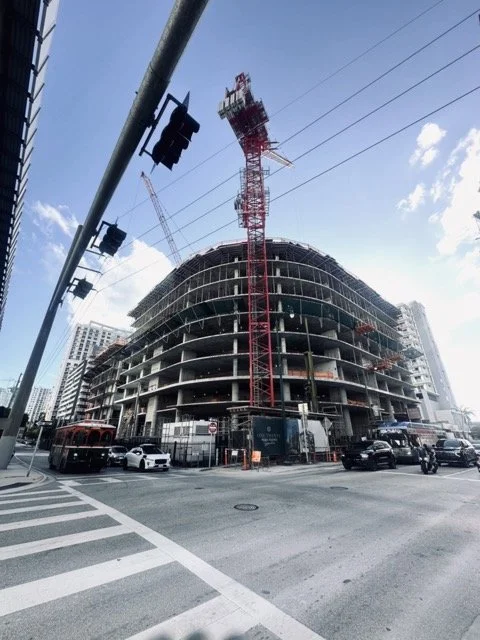
One Twenty Brickell, photo by Nadia Bouzid
The proposed package included an $860 million construction loan from J.P. Morgan and approximately $250 million in C-PACE financing from Nuveen Green Capital. Commercial Observer reported that term sheets had been signed, with closing expected by year end. It explicitly stated that the transaction had not closed. October 21 reporting still described the refinancing as being sought.
For a purchaser who committed money earlier, the distinction has immediate consequences. The development has had financing, yet its progress now depends on another transaction. The building’s timetable and the debt’s timetable have become part of the same problem.
The foreclosure allegations remain contested. JDS brought a separate suit accusing Cottonwood, whose affiliate acquired the loan, of misusing confidential information obtained during refinancing discussions. Neither a foreclosure complaint nor an announced rescue package establishes the eventual outcome. What they reveal is the financial transition taking place while purchasers remain committed to their contracts.
That is the part of preconstruction financing worth understanding before selecting an apartment. A loan closing establishes a source of capital under particular terms. Its significance depends on what the money finances, how long it remains available and what must happen before it comes due.
At 888 Brickell by Dolce&Gabbana, also developed by JDS, the publicly reported financing is at a different stage. The site was acquired for $61.2 million in 2024 with a $35.7 million acquisition loan from G4 Capital Partners. October coverage reported that JDS was seeking a minority equity investor through Newmark while intending to remain involved. That describes ownership and capital being assembled around a proposed development; it does not establish a closed construction loan for the tower.
The project has also faced a suit from One Sotheby’s alleging unpaid commissions, marketing fees and expenses. That dispute deserves accurate treatment on its own terms. It is not a construction loan foreclosure, and the difficulties at Mercedes-Benz Places cannot simply be transferred to another property because the developer is the same.
These distinctions matter when comparing developments whose presentations appear equally complete. Architecture, interiors and a recognizable brand give you a detailed picture of what is being offered. The financing reveals something about the work and obligations required to deliver it.
A closed construction loan remains a substantial milestone. A lender has assessed the developer’s financial capacity, equity contribution, contractor, budget and feasibility of completing the project. That scrutiny adds credibility because money is being committed against the assessment. It also introduces ongoing oversight: construction funds are generally released through draws supported by inspections and documentation, rather than handed over in full at closing.
The lender’s assessment, however, concerns repayment of its debt. Your purchase concerns a particular residence, at an agreed price, with specifications and delivery provisions that matter to you. The same project can present different risks to each party because their contracts, collateral and financial exposure differ.
Even the size of a financing announcement requires context. Cipriani Residences Miami’s $600 million package included $350 million from Banco Inbursa and $250 million from Ascendant Capital Partners. JEM’s $465 million financing combined traditional construction loans with C-PACE financing. One Brickell Riverfront’s $513 million package supports two towers. Comparing those headline figures without their scope gives little indication of which development is more conservatively financed.
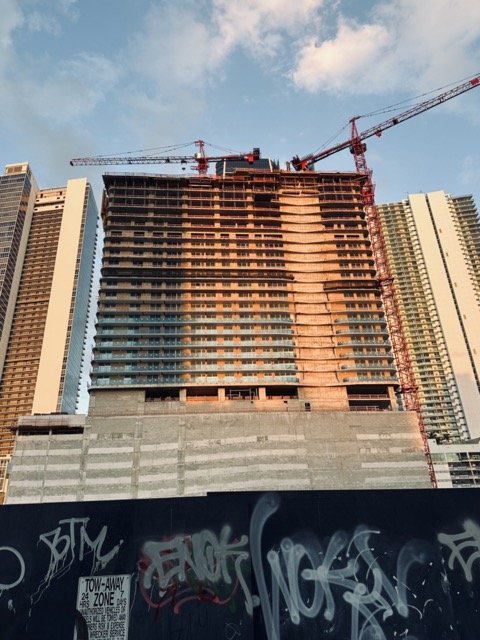
JEM, photo by Nadia Bouzid
The same care applies to presales. There is no universal Florida requirement that a condominium be 50% sold before its construction financing can close. Lenders establish their own conditions. First American Bank’s outlook for 2026 describes condominium presale requirements as often falling between 25% and 50%, a useful reference from one bank rather than a rule governing Miami’s market.
Actual transactions show the variation. Cipriani was reported as more than 50% presold when its financing closed in February 2024. Baccarat announced its construction loan the following month with more than 95% sold. Those figures describe their sales at the time; they do not disclose the minimum either lender required.
Nor does a percentage sold explain how much money has been collected. Reservations, binding contracts and paid deposits represent different levels of commitment. The unit count also obscures the value of the contracts: several expensive residences can change the revenue picture considerably without producing a dramatic change in the percentage reported.
Your own deposit participates in this calculation. Florida law generally requires payments up to the first 10% of the purchase price to be escrowed, with provisions for approved alternative assurances. Amounts above 10% may be released for permitted construction purposes once work begins if the contract allows it and the statutory conditions are met. Understanding which portion remains held and which portion may be spent is essential when committing substantial installments before closing.
For an international purchaser accustomed to a different deposit regime, the payment schedule deserves as much attention as the floor plan. Your liquidity may be committed for years, and some of those funds may help finance the work.
The following transactions identify selected publicly announced closed construction financings in Brickell and Downtown Miami. Amounts refer to the financing announced, not current outstanding balances or confirmation that all funds have been disbursed.
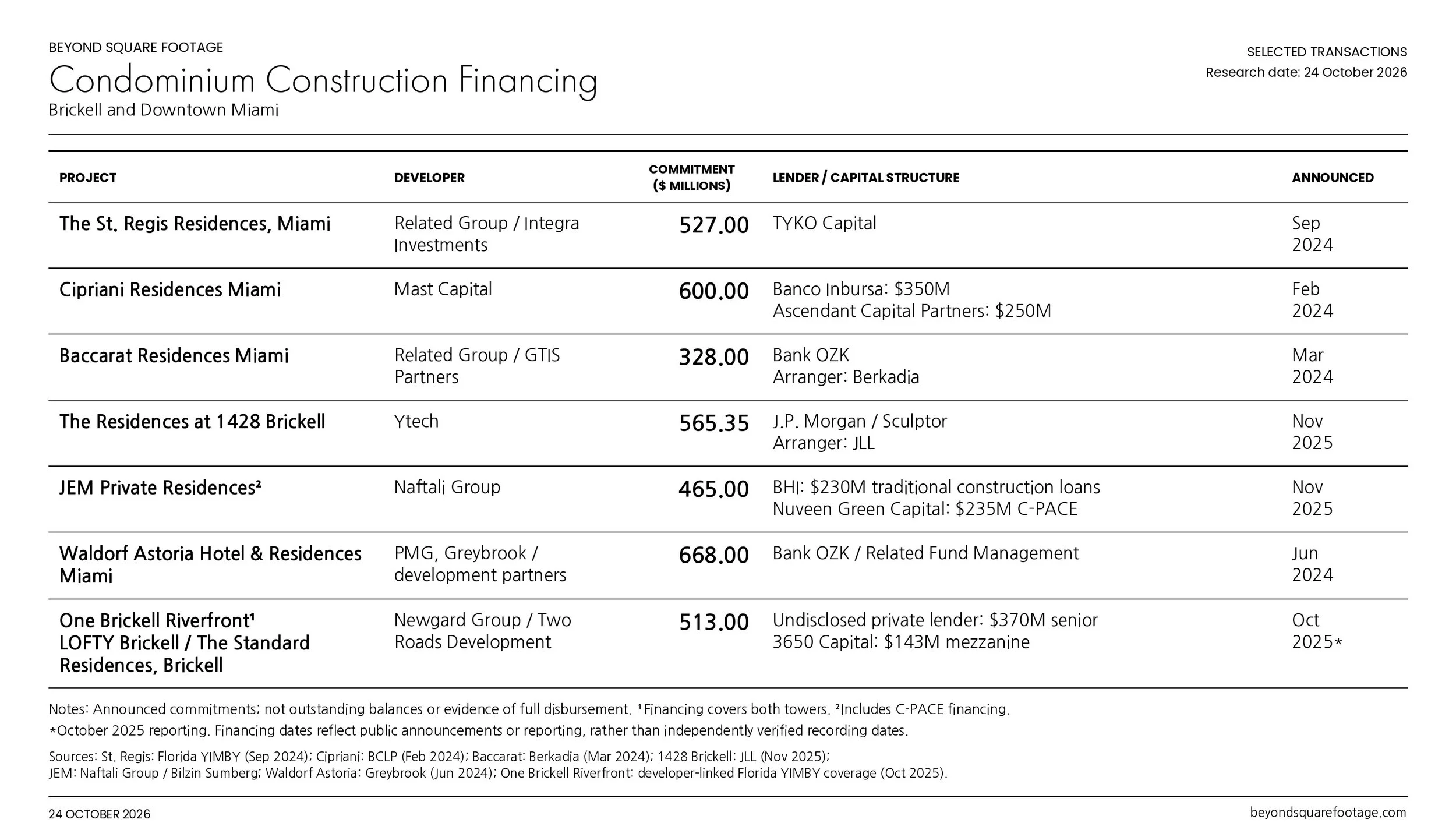
A closing date gives this information a necessary reference point. At 1428 Brickell, JLL’s November 2025 announcement identifies a 4.25-year loan term. That detail offers more to consider than the amount alone: how the financing period relates to construction, completion and the sale of residences.
Construction financing does not certify craftsmanship, resale value or the availability of your mortgage at closing. It does establish that a development has passed a significant financial test. The absence of a public loan announcement, meanwhile, does not prove a developer lacks the resources to build; other capital arrangements exist.
The useful judgment lies in knowing which stage you are entering. A project assembling equity, one with signed financing term sheets and one drawing on a closed construction facility present different circumstances, even when all three are actively selling apartments.
Mercedes-Benz Places makes the timing particularly clear. An earlier loan reached maturity before the next financing transaction was completed. For a buyer, that interval can affect far more than construction progress. It can extend the period during which deposits are committed, plans remain unsettled and delivery depends on negotiations outside the purchase contract.
Before paying for a future residence, understand what still needs to be financed and who is responsible if the original budget or timetable no longer works. A lender may be satisfied with the protection it negotiated. Your purchase agreement needs to be read with the same attention to your own position.