Yayoi Kusama: “My Eternal Soul”, at the National Art Center Tokyo
![Yayoi Kusama: My Eternal Soul [at the National Art Center Tokyo] | Photo by Nadia Bouzid](https://images.squarespace-cdn.com/content/v1/56703520d8af1045cf9bcf0d/1507340887732-0Z0X99PSFKBPM5WAEKU3/Yayoi+Kusama%7C+My+Eternal+Soul)
Yayoi Kusama: My Eternal Soul [at the National Art Center Tokyo] | Photo by Nadia Bouzid
Artist: Yayoi Kusama
Exhibition: My Eternal Soul
Museum: The National Art Center, Tokyo
Dates: February 22 to May 22, 2017
Paintings from the series: 132
Series started: 2009
Earlier works in the exhibition: Approximately 80
Yayoi Kusama’s dots are everywhere right now. On pumpkins, mirrored rooms, trees and, a few years ago, an entire Louis Vuitton collection. Even people who know little about her work recognize a Kusama.
My Eternal Soul at The National Art Center in Tokyo goes much further than the dots. The exhibition brings together 132 large paintings from the series she started in 2009, followed by approximately 80 earlier works tracing her career from Matsumoto to New York and back to Tokyo.
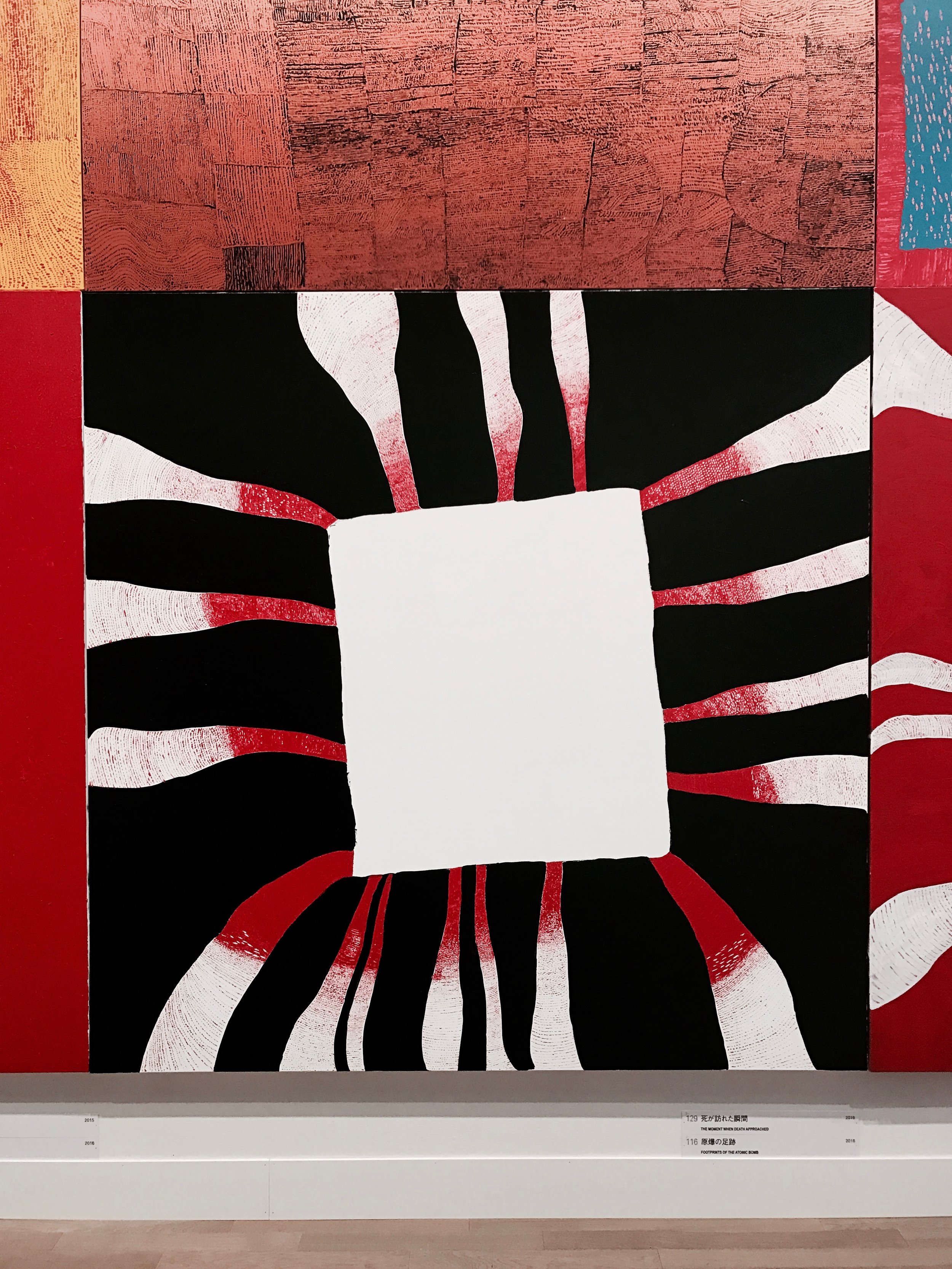
The main room is packed with paintings. They hang close together across long white walls, most of them on square canvases measuring approximately 194 by 194 centimeters. The repeated format gives the room some order. The paintings themselves do not.
There are eyes, profiles, flowers, faces, nets, dots and small organisms that seem to be multiplying. Some canvases look cheerful from across the room and slightly disturbing once you get closer. A bright flower sits beside a face with teeth. Eyes become petals. Dots start looking like cells.
![Yayoi Kusama: My Eternal Soul [at the National Art Center Tokyo] | Photo by Nadia Bouzid](https://images.squarespace-cdn.com/content/v1/56703520d8af1045cf9bcf0d/1507337911265-JV1A6KF6VGW88A8J6FG2/Yayoi+Kusama+My+eternal+Soul)
Yayoi Kusama: My Eternal Soul [at the National Art Center Tokyo] | Photo by Nadia Bouzid
The paintings are loud and crowded, with very little empty space. Kusama is now eighty eight, but there is nothing restrained about this stage of her work. She keeps adding colors, figures and symbols until every part of the canvas is occupied.
One painting can be read through the familiar Kusama motifs. Seeing 132 together is different. Faces mutate from one canvas to the next. Dots become flowers, planets and eyes. Certain forms repeat, disappear and then return several paintings later in another color.
The rest of the exhibition explains where all of this comes from. It begins with works from Matsumoto, where Kusama was born in 1929 and started drawing and painting as a child. Plants, nets and strange biological forms appear early. They are already hers, long before they become famous.
Kusama briefly studies nihonga, traditional Japanese painting, at the Kyoto Municipal School of Arts and Crafts. The rigid system does not suit her, so she returns to Matsumoto and works independently. During the 1950s, she paints abstract forms alongside plants, animals, city scenes and images of the universe.
She moves to the United States in 1957 and settles in New York the following year. Her Infinity Net paintings cover large canvases with thousands of small repeated marks. They have no obvious center and nowhere comfortable for the eye to rest.
![Yayoi Kusama: My Eternal Soul [at the National Art Center Tokyo] | Photo by Nadia Bouzid](https://images.squarespace-cdn.com/content/v1/56703520d8af1045cf9bcf0d/1507337996451-J91F9HULWPROBLR37A2D/The+National+Art+Center+Tokyo)
Yayoi Kusama: My Eternal Soul [at the National Art Center Tokyo] | Photo by Nadia Bouzid
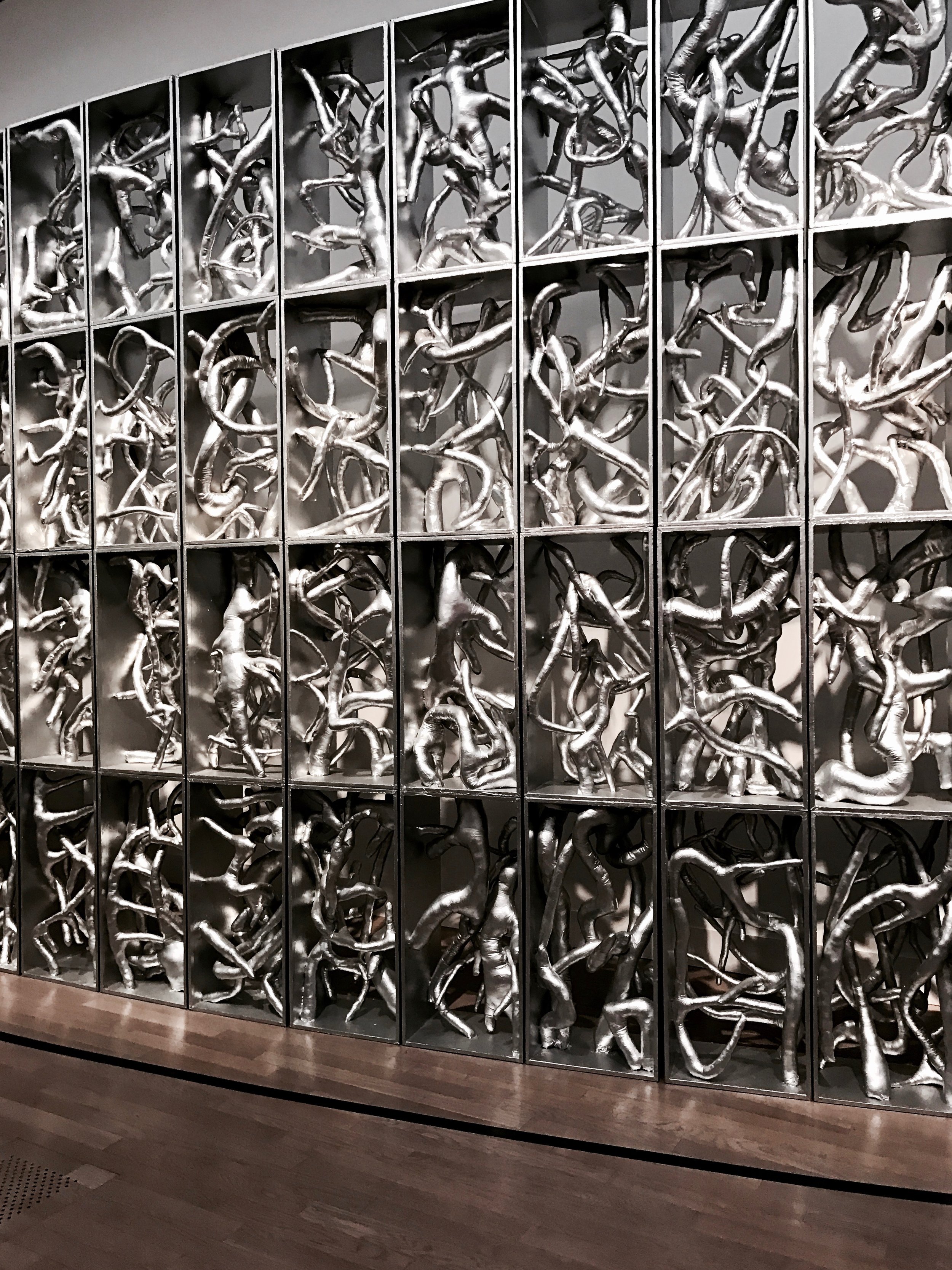
During the 1960s, her work moves beyond the canvas. She covers furniture and ordinary objects with soft sewn forms, creates installations and stages public performances. Food, sex and accumulation appear repeatedly. Objects, bodies and rooms begin to disappear beneath the work.
Kusama returns to Japan in 1973 and continues working across painting, sculpture, collage, printmaking, fiction and poetry. The colors become brighter and the images more figurative, but the earlier ideas remain. Dots, nets, flowers, bodies and infinity keep returning in different forms.
That history changes the way the new paintings look. My Eternal Soul is not a separate late chapter. Everything is still in there. The quiet Infinity Nets from New York now share the canvas with faces, flowers, eyes and strange little creatures that seem to come from somewhere much more private.
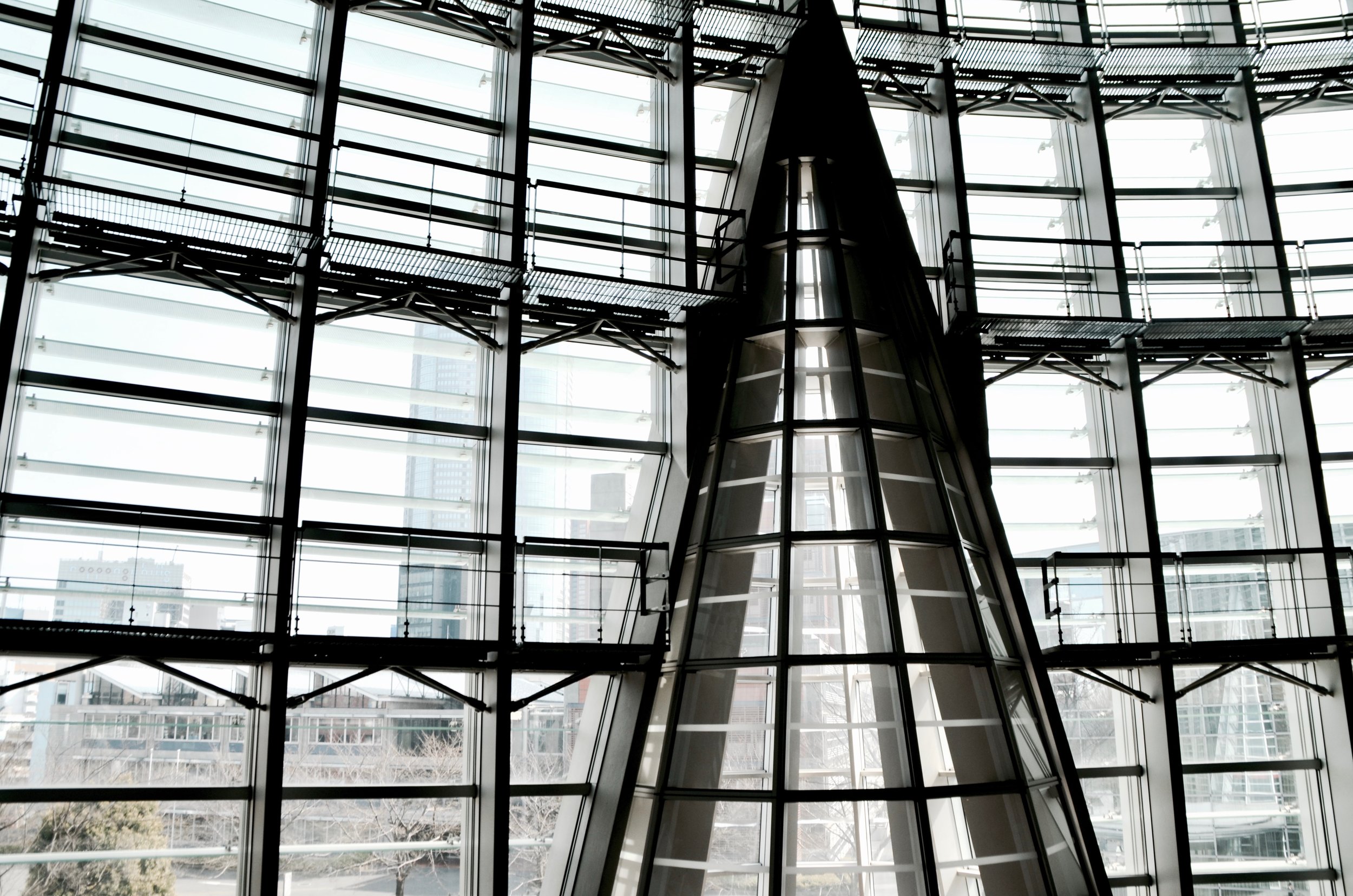
The exhibition starts before entering the museum. Trees outside The National Art Center are wrapped in red fabric covered with white dots. Inside, the galleries move through drawings, paintings, sculptures and mirrored installations. There is also the black and yellow YELLOW TREE Living Room, a furniture project Kusama created with the Osaka design group graf.
The mirrored rooms are the obvious draw, but the paintings need more time. You have to move closer, step back and look again. There is always another face, eye or form hiding somewhere in the pattern.
Kusama was included in Time magazine’s list of the 100 most influential people in 2016. Her exhibitions have traveled through the Reina Sofía in Madrid, Tate Modern in London, the Centre Pompidou in Paris and the Whitney Museum in New York. She is now one of the most recognizable artists in the world.
The scale of My Eternal Soul makes that fame feel secondary. Kusama is eighty eight and still producing new work at an extraordinary pace. The largest room in the exhibition is not filled with greatest hits. It is filled with paintings she is making now.
Gallery


![Yayoi Kusama: My Eternal Soul [at the National Art Center Tokyo] | Photo by Nadia Bouzid](https://images.squarespace-cdn.com/content/v1/56703520d8af1045cf9bcf0d/1507340467250-EUNP4CU5RRM8CQ4LTHS7/IMG_0810.jpg)
![Yayoi Kusama: My Eternal Soul [at the National Art Center Tokyo] | Photo by Nadia Bouzid](https://images.squarespace-cdn.com/content/v1/56703520d8af1045cf9bcf0d/1507340459701-4U4HS4Z9IUSCWXMCLJNU/IMG_0807.jpg)
![Yayoi Kusama: My Eternal Soul [at the National Art Center Tokyo] | Photo by Nadia Bouzid](https://images.squarespace-cdn.com/content/v1/56703520d8af1045cf9bcf0d/1507340342507-CV5HBOJAWAWZNH38V9CX/DSC_0385.jpg)
![Yayoi Kusama: My Eternal Soul [at the National Art Center Tokyo] | Photo by Nadia Bouzid](https://images.squarespace-cdn.com/content/v1/56703520d8af1045cf9bcf0d/1507340340981-XR2MJC2PYVS31GQ7EFK1/DSC_0383.jpg)
![Yayoi Kusama: My Eternal Soul [at the National Art Center Tokyo] | Photo by Nadia Bouzid](https://images.squarespace-cdn.com/content/v1/56703520d8af1045cf9bcf0d/1507340388995-SJWFYLABWRJUB2NH54XE/IMG_0782.jpg)
![Yayoi Kusama: My Eternal Soul [at the National Art Center Tokyo] | Photo by Nadia Bouzid](https://images.squarespace-cdn.com/content/v1/56703520d8af1045cf9bcf0d/1507340349002-RQKRMP7OXUZJ2XJYDPWO/DSC_0386.jpg)
![Yayoi Kusama: My Eternal Soul [at the National Art Center Tokyo] | Photo by Nadia Bouzid](https://images.squarespace-cdn.com/content/v1/56703520d8af1045cf9bcf0d/1507340389656-9U5Q2MJ8G1ZI631HYUOQ/IMG_0781.jpg)
![Yayoi Kusama: My Eternal Soul [at the National Art Center Tokyo] | Photo by Nadia Bouzid](https://images.squarespace-cdn.com/content/v1/56703520d8af1045cf9bcf0d/1507340462296-C6S071KDZWXPAEVTOKLK/IMG_0809.jpg)








![Yayoi Kusama: My Eternal Soul [at the National Art Center Tokyo] | Photo by Nadia Bouzid](https://images.squarespace-cdn.com/content/v1/56703520d8af1045cf9bcf0d/1507338027607-BD6BI6COVNQPRZ4PH0L2/Yayoi+Kusama+Tree+Tokyo)
Yayoi Kusama: My Eternal Soul [at the National Art Center Tokyo] | Photo by Nadia Bouzid
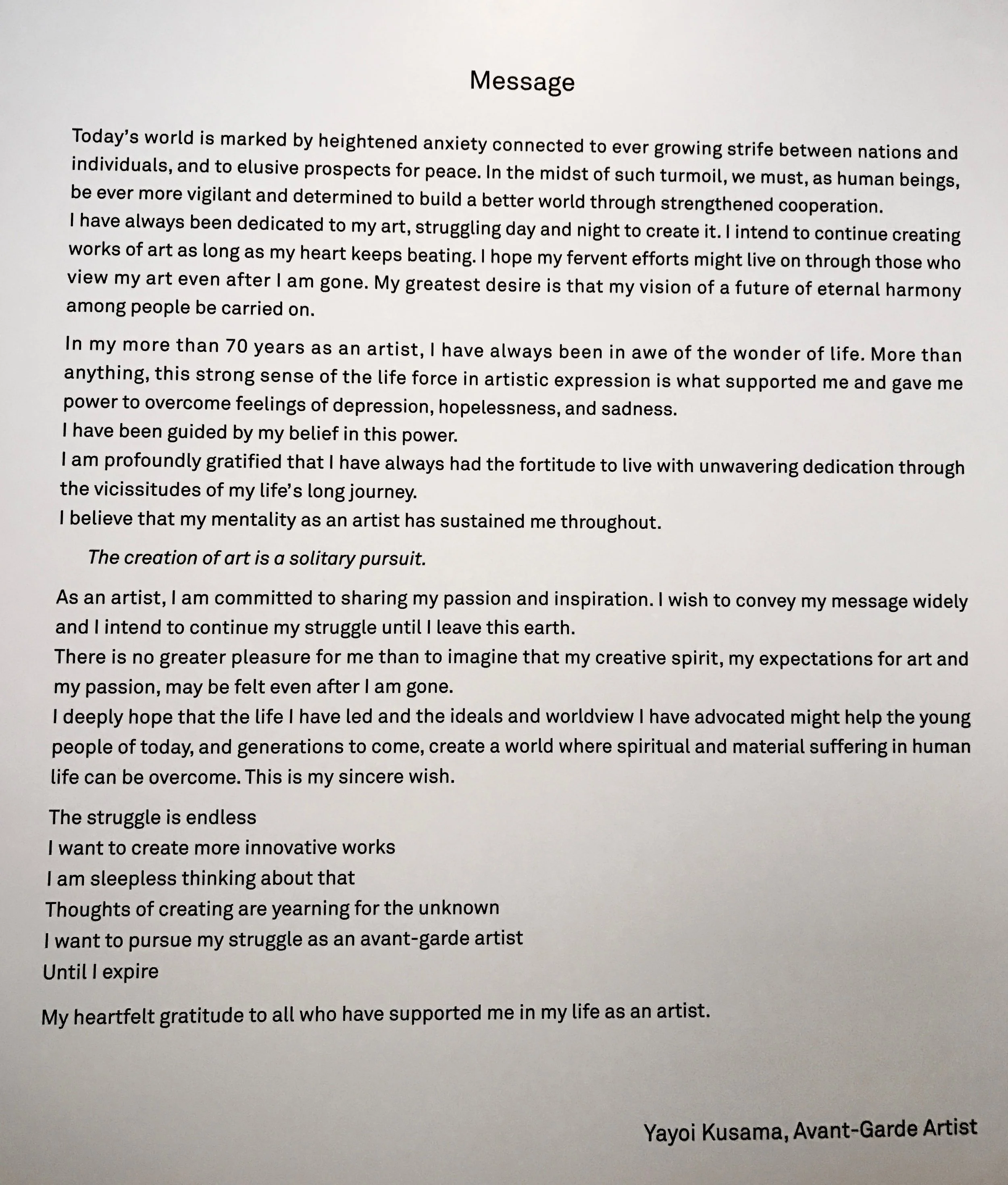
Artist's Message | Yayoi Kusama
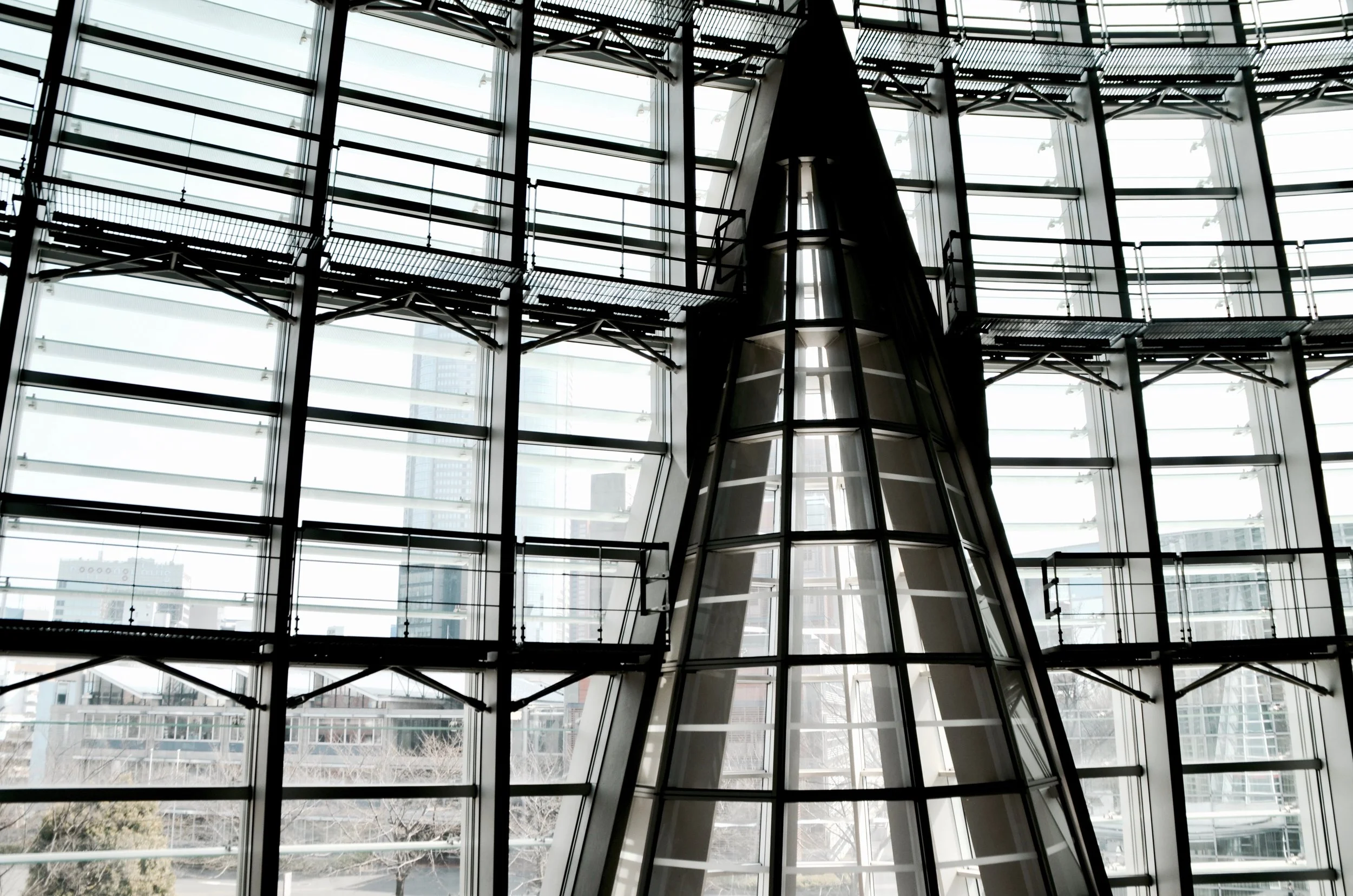
National Art Center Tokyo | by Nadia Bouzid
Exhibition outline via National Art Center Tokyo
Kusama in the 21st Century
Kusama is included in TIME magazine’s 2016 list of the 100 Most Influential People in the World. In 2014, Art Newspaper named her the world's most popular artist. Her solo exhibition that toured Reina Sofia (Madrid), Tate Modern (London), the Centre Pompidou (Paris) and the Whitney Museum (New York) received extensive press coverage. Touring exhibitions in Latin America, Asia, and Northern Europe followed.
"My Eternal Soul"
The "My Eternal Soul" series, begun in 2009, is an ongoing project currently comprising over 500 paintings. In the early stages of production, Kusama used several sizes of canvas, measuring 162×130.3cm, or 162×162cm. Later, the size standardized to a quasi-square canvas measuring 194×194cm. The series is marked by astonishing variety, incorporating abstract patterns as well as natural forms. It represents the essence of Kusama’s art, and is an embodiment of all the elements of her corpus of work.
2. Kusama in the 20th Century
Kusama in Matsumoto
Interested in painting since childhood, Yayoi Kusama began to study nihonga (Japanese-style paintings) at the Kyoto Municipal School of Arts and Crafts. She became disenchanted with the course, and instead went on to create independently at her home in Matsumoto. In the 1950s, Kusama depicted abstract as well as natural forms, and developed a variety of motifs based on plant and animal forms, the planets and universe, and urban landscapes. Art critic Shūzō Takiguchi recognized her abilities and organized several solo exhibitions for her in Tokyo.
Kusama in New York 1957-73
Kusama felt limited in Japan. In the autumn of 1957, she moved to the United States and settled down the following year in New York. Her Infinity Nets paintings, vast fields of canvas filled with monochrome strokes with no center, and no structure, quickly gained attention. Following that, her work revealed obsessions with sex and food. She produced furniture with appended soft sculpture phallic forms, accumulations and installations, as well as Happenings (performance art).
Kusama in Tokyo
In 1973, Kusama returned to Tokyo due to ill health. She continued creating while staying in the hospital. Motifs of her work include polka dots, nets, and phallic imagery in paintings, sculptures, and installations. Vivid colors and figurative motifs emerged as new elements during this period. She also began work in media such as collage, engraving, and in the writing of fiction and poetry. Her straightforward expression related to the subjects of death, sex, and the infinite universe attracted new audiences. Her artistic horizons also broadened through a number of collaborations.

Mural of Yayoi Kusama in Wynwood By Chloe Hakakian 2028 | Photo by Nadia Bouzid
WHO IS YAYOI?
A groundbreaking artist renowned for her avant-garde work spanning various mediums such as painting, sculpture, performance art, and installations. Born in Matsumoto, Japan, in 1929, Kusama's artistic journey began at a young age, and she later gained global recognition for her innovative creations characterized by bold colors, repetitive patterns, and a sense of infinity. Despite facing personal struggles, Kusama's determination and creativity have left an indelible mark on the art world, making her one of the most influential artists of our time.
Yayoi Kusama: A Life of Triumph Over Adversity and Creative Collaboration

PUMPKIN | photo by Nadia Bouzid
Yayoi Kusama's journey from a small town in Japan to international acclaim as an avant-garde artist is not just a story of creativity but also one of resilience and overcoming personal struggles. Her collaborations with leading brands have not only expanded her influence but also served as a testament to her ability to transcend adversity and inspire others.
Early Life and Artistic Journey:
Born in Matsumoto, Japan, in 1929, Yayoi Kusama discovered her passion for art at a young age. Despite facing familial opposition, she pursued her dreams and eventually moved to New York City in the late 1950s. There, she immersed herself in the city's vibrant art scene, creating bold and imaginative works that garnered critical acclaim.
Time in the Asylum:
However, Kusama's success was accompanied by personal challenges, including struggles with mental health. In the late 1970s, she voluntarily admitted herself to a psychiatric hospital in Japan, where she has lived voluntarily ever since. Despite the hardships she faced during this time, Kusama continued to create art, using it as a form of therapy and self-expression.
Collaborations with Brands:

Yayoi Kusama | Photo by Nadia Bouzid
Kusama's resilience and creativity have not gone unnoticed, leading to collaborations with numerous brands eager to harness her unique artistic vision. In 2012, she partnered with Louis Vuitton to create a line of luxury handbags, accessories, and clothing featuring her iconic polka dots. This collaboration brought her art to a new audience, blurring the lines between fashion and fine art.
Additionally, Kusama collaborated with cosmetics giant Shu Uemura to produce a vibrant collection of makeup inspired by her bold colors and patterns. These collaborations allowed fans to incorporate Kusama's artistic flair into their everyday lives, further cementing her status as a cultural icon.
Legacy:
Yayoi Kusama's life and work serve as an inspiration to artists and individuals around the world. Her ability to overcome personal struggles and channel them into her art is a testament to the transformative power of creativity. Through her collaborations with brands, she has expanded her influence and brought her art to new audiences, leaving a lasting legacy that continues to inspire generations to come.


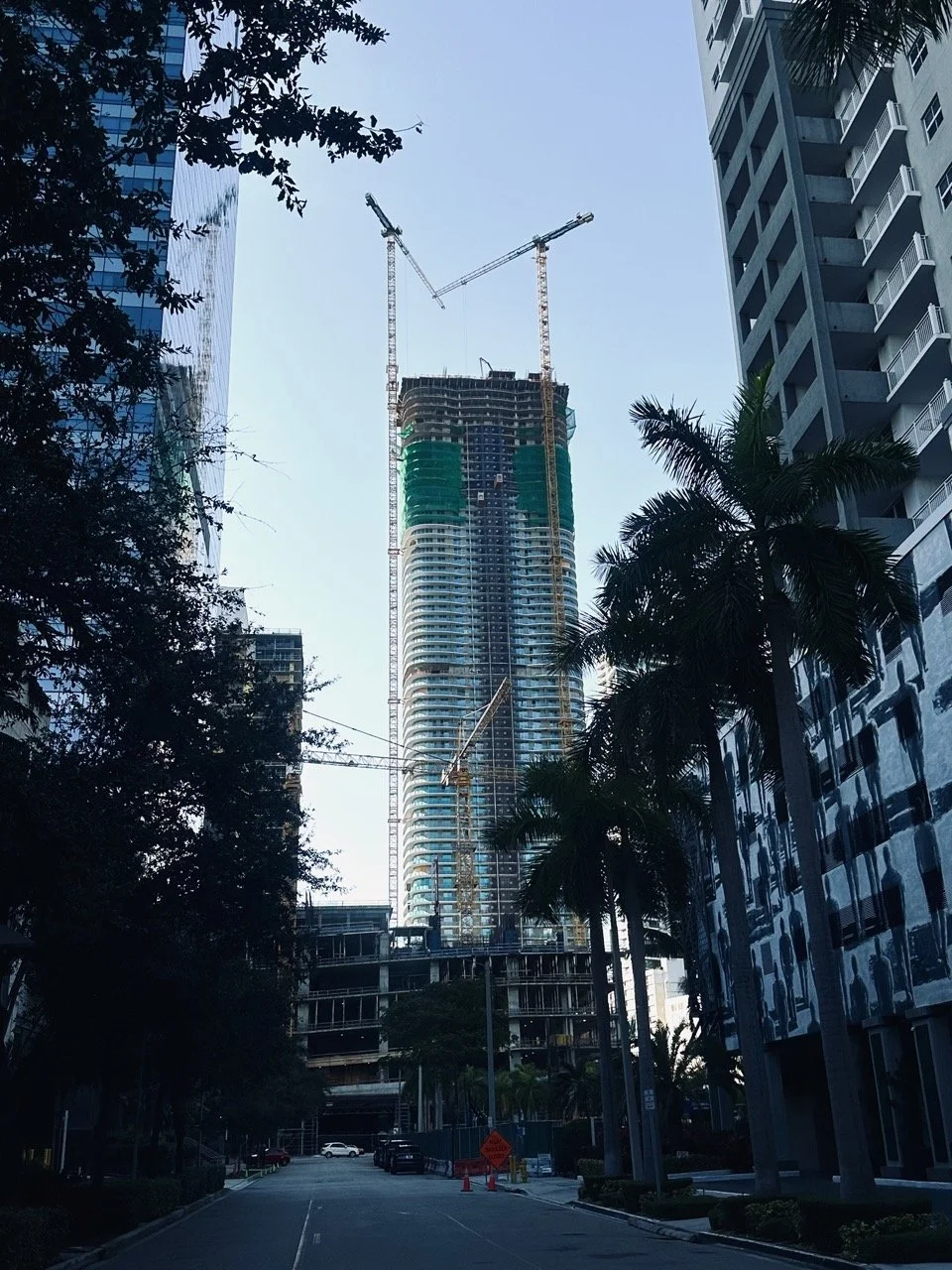





Closed loans, pending financing and refinancing disputes: what Mercedes-Benz Places and other Miami condo projects reveal about preconstruction buyer risk.